THE GREENWASHING OLYMPICS
Why you need to read the SDS sheets before spraying anything on your kitchen bench
You know what drives me absolutely nuts?
When a cleaning product slaps a couple of green leaves on the bottle, throws the words “plant‑based” and “eco” around, and suddenly everyone thinks it’s safe enough to spray on the high chair, the chopping board, the dog, the baby — whatever. But here’s the thing nobody tells you:
The marketing label is a fairy tale. The SDS sheet a clue to the truth. And the truth? It’s not cute, it’s not pretty, and it’s usually NOT GREEN.
What an SDS Sheet Actually Is
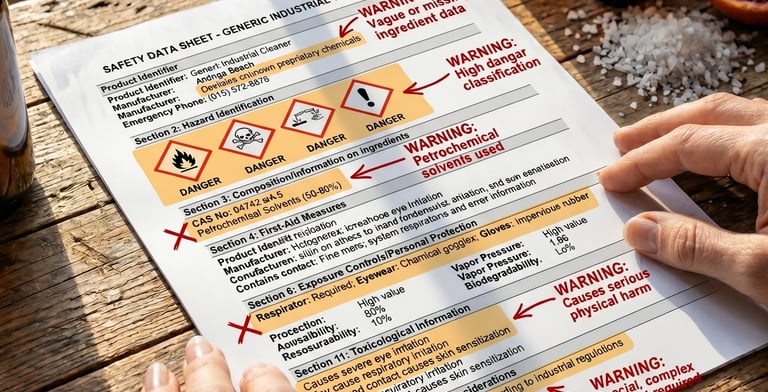
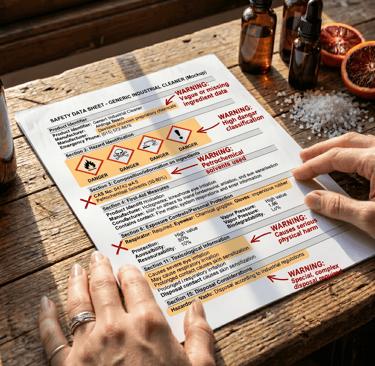
An SDS (Safety Data Sheet) is the legally required document that tells you what the product really is, what it can actually do, what PPE you’re supposed to wear, what to do if it spills, whether it’s safe around food, whether it’s toxic to the environment, whether it builds up in your body, and whether it’s hazardous. It’s the adult version of “what’s really in this stuff?” And let me tell you… some of these “eco” products? They’re industrial‑strength chemical cocktails dressed up like a rainforest.
The Non‑Hazardous Lie (and Why It Means Nothing)
However, one of the biggest traps in Australia is the term “Non‑Hazardous” on an SDS. It sounds reassuring — but it’s basically meaningless. Under Australian classification rules, a product is only considered hazardous if it meets extreme criteria like explosive, flammable, corrosive, acutely toxic, carcinogenic, mutagenic, reproductive toxin, or causes immediate severe harm. So unless your kitchen spray is basically nuclear waste, it can legally be labelled “Non‑Hazardous” — even if it irritates skin, damages lungs, requires PPE, is unsafe around food, is harmful to waterways, has unknown environmental impact, or is designed for industrial equipment.
“Non‑Hazardous” does not mean safe. It does not mean gentle. It does not mean eco‑friendly. It simply means it doesn’t meet the threshold for the worst types of chemical danger. And that’s how industrial‑strength cleaners get away with being marketed as “eco”.
Eco on the Front, Industrial Cleaner on the Back
I recently looked up the SDS for a very popular “eco” multipurpose spray sold in a major supermarket. I’m not naming brands — I don’t need to. The pattern is everywhere. The front label says “Plant‑based formula”, “Grey water and septic tank safe”, green leaves, green colours, “Multipurpose”. It oozes wholesome, safe, nature‑vibes.
But the SDS? Oh my lord. The SDS says the recommended use is vehicle wash, workshop floors, machine parts, industrial equipment. You know… all the things you definitely have in your kitchen. It gets better.
The SDS also says: Poison schedule: Unknown. Wear safety glasses. Avoid inhalation of vapours. Avoid repeated skin contact. Keep away from food. Use near an eyewash station. Clean small spills with PPE and dispose in labelled drums.
Meanwhile people are spraying this on their benchtops while their toddler eats a banana two metres away.
And the environmental section? Ecotoxicity: No information available. Bioaccumulation: No information available. Persistence: No information available.
But sure — slap a leaf on the bottle and call it eco.
This Isn’t About One Brand — It’s the Whole Industry
This isn’t a “gotcha” moment for one product. This is a systemic pattern: green packaging, nature imagery, “plant‑based” claims, zero transparency, SDS sheets that tell a completely different story. People deserve to know what they’re bringing into their homes. People deserve honesty. People deserve products that don’t require PPE to wipe a kitchen bench.
How to Protect Yourself (Without Needing a Chemistry Degree)
Here’s what to look for when you check an SDS:
Recommended Use: If it says “vehicle wash”, “industrial equipment”, or “workshop floors” — it’s not a kitchen spray.
PPE Requirements: If it says “wear safety glasses”, “avoid inhalation”, or “avoid skin contact” — it’s not a kitchen spray.
Food Safety Warnings: If it says “keep away from food” — it’s not a kitchen spray.
Environmental Data: If the SDS says “no information available” for ecotoxicity — it’s not eco.
Poison Schedule: If it says “unknown” — run.
Why I Care (and Why Eco‑Ness Exists)
I’m not here to scare people. I’m here to educate and empower.
And yes, I make cleaning products. Mine are simple, transparent, genuinely plant‑based, safe for homes, safe for skin, and safe for the environment. No greenwashing. No industrial surprises. No PPE required. Just honesty.
Final Thought
If a product needs safety glasses, an eyewash station, and a spill‑response plan… it probably shouldn’t be on your kitchen bench. Check the SDS. Trust your gut. And don’t let a leaf on a bottle fool you.
Peace out - Ness x